
Build-A-Black™
Or: How Generative AI Learned to Do Racism Faster Than the Government

She is not real.
Neither is the loud Black man at Popeyes.
Nor the woman screaming about food stamps.
Not the baby mama.
Not the thug.
Not the “why can’t I buy Hennessy with EBT” performance art piece.
All fake.
But let’s be serious.
Since when has racism ever needed a fact check ?
You think the most powerful weapon in the world is a nuke?
Cute.
It’s propaganda..
Missiles blow up buildings.
Propaganda blows up perception.
And perception is cheaper.
You don’t have to police a population as aggressively if you can convince everyone they’re dangerous in advance. You don’t have to justify inequality if people already believe certain groups “just be like that.”
America figured this out early.
White supremacy isn’t just about violence. Violence is messy. Violence requires headlines. Violence leaves evidence.
Belief?
Belief is self-sustaining.
Pair that belief with capitalist which is always looking for a group to underpay, overwork, or incarcerate and you’ve got yourself a system that runs smoothly as long as the story makes sense.
And media makes it make sense.
The Original DLC Pack
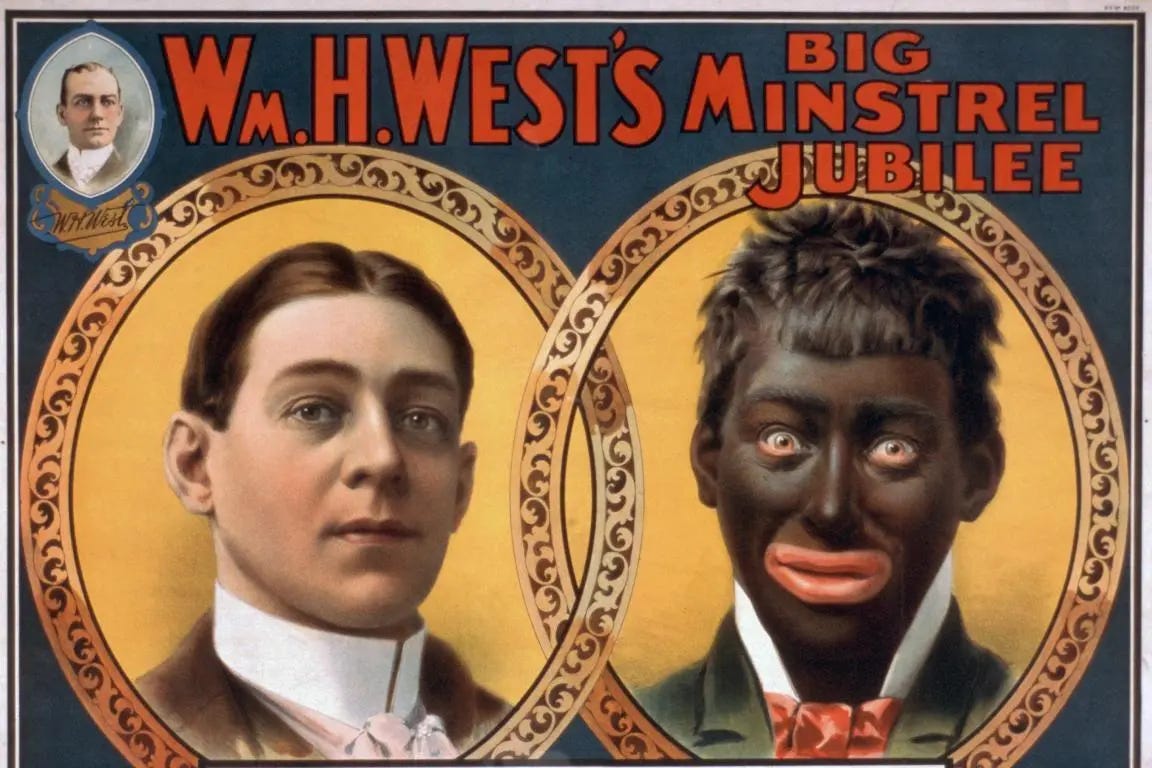
Before AI, racism had to be handcrafted.
Step one: extract.
Take Blackness. Remove history. Remove policy. Remove redlining. Remove surveillance. Remove underfunded schools. Remove labor exploitation.
Now what’s left ?
Volume.
Attitude.
Crime statistics with no context.
A freeze-frame mid-argument.
Perfect.
Minstrel performers like Thomas D. Rice figured this out in the 1800s. Just exaggerate everything and call it authenticity.
Then Hollywood leveled up with The Birth of a Nation. Shoutout to D. W. Griffith for turning white terrorism into a feel-good superhero flick before capes were even invented.
Black men as brutes.
White violence as heroism.
The audience didn’t debate it.
They absorbed it.
And then they acted accordingly.
That’s the real trick. Not persuasion. Conditioning.
Let’s Fast forward
November 30, 2022.
OpenAI drops ChatGPT 3.5.
Everybody’s like: “Wow, essays in five seconds! The future!”
Meanwhile, the archive is stretching its back like, “Oh word? We multiplying now?”
Generative AI is not evil. It’s efficient.
It studies patterns. It predicts what comes next. It pulls from the dataset of the internet.
And what is the internet?
A landfill of:
Sensational crime clips.
Viral “ghetto” compilations.
Reaction channels built entirely on Black humiliation.
Comment sections auditioning for the Klan reboot.
The machine doesn’t understand context.
It understands probability.
If the data says Black face + chaos = high engagement, the model says, “Bet.”
That’s not ideology.
That’s math trained on centuries of distortion.
Build-A-Black Workshop™
Welcome to the future.
Why hire a Black actor when you can generate one?
Why pay a Black writer when you can approximate “urban dialogue”?
Why deal with real Black communities and their inconvenient demands for justice when you can just simulate them misbehaving?
Artificial Blackness is amazing.
Never asks for a raise.
Never files a lawsuit.
Never mentions redlining.
Never unionizes.
Just logs in, performs dysfunction, and logs out.
And because it’s not a real person, there’s no accountability. You can make it as loud, ignorant, violent, hypersexual, or chaotic as your engagement metrics require.
Need a viral clip proving “this is why cities are failing”?
Generate.
Need a thumbnail that says “Black Fatigue”?
Generate.
Need a fake argument about EBT and Hennessy to confirm what Uncle Steve already believes at Thanksgiving?
Generate.
We’ve officially automated the caricature.
The Flood Strategy (Or: Racism on Autoplay)
Here’s the part that’s actually sinister.
It’s not one fake video.
It’s saturation.
Your feed becomes:
Another loud Black woman.
Another aggressive Black man.
Another “urban chaos” scenario.
Another exaggerated accent.
None confirmed. None contextualized. All familiar.
And your brain trained since childhood on extraction and synthesis — fills in the blanks.
You don’t even realize you’re doing it.
You think you’re observing reality.
You’re recognizing an archetype.
That archetype has been rehearsed since minstrel stages, refined in early cinema, perfected on cable news, and now industrialized by algorithms.
AI didn’t invent the lie.
It just put it on autopilot.
Here’s where it gets uncomfortable.
Once a system can generate convincing Black avatars, representation no longer requires Black participation.
That’s the dream, right?
You get:
Black aesthetics.
Black slang.
Black bodies.
Black dysfunction for political leverage.
Without Black resistance.
Artificial Blackness becomes safer than actual Black life.
Because real Black people protest.
Real Black people vote.
Real Black people organize.
Real Black people ask, “Why?”
Artificial Blackness just performs.
And performs.
And performs.
The scariest part isn’t that it’s fake.
It’s that it feels real.
Because the stereotype has always been waiting.
Generative AI doesn’t need to convince you from scratch. It just needs to trigger what’s already been conditioned.
A freeze-frame.
A caption.
A comment section doing the rest.
You scroll.
Another one.
Scroll.
Another one.
At some point, the question stops being “Is this real?”
It becomes, “Why are they always like this?”
And just like that, the hierarchy is comfortable again.
No legislation required.
No open hatred necessary.
Just vibes.
Just algorithms.
Just probability curves shaped by a racist archive.
What happens when artificial Blackness becomes more visible than actual Black life?
When the average person encounters more AI-generated caricatures than real Black neighbors?
When engagement metrics determine which version of us spreads the fastest and nuance never wins that race?
You don’t need to eliminate a people physically if you can overwrite them perceptually.
If the dominant image of Blackness becomes synthetic dysfunction, then every real Black person must now fight a digital ghost before they even open their mouth.
You walk into a room already pre-interpreted.
You speak, and the algorithm has already supplied the subtitles.
The endgame isn’t dramatic.
There won’t be a cinematic collapse where someone flips a switch and declares, “Representation is dead.”
It will feel gradual.
You’ll notice fewer real stories breaking through.
You’ll notice more exaggerated ones rising.
You’ll notice how quickly people generalize from clips that were never verified.
You’ll notice how often someone says, “I’ve seen it too many times,” without realizing they’ve mostly seen simulations.
And by then, the environment will already be shaped.
Because propaganda’s greatest achievement isn’t convincing you to hate.
It’s convincing you that what you’re seeing is simply how things are.
Natural.
Inevitable.
Self-explanatory.
That’s when hierarchy becomes invisible again.
That’s when the machine doesn’t need to scream.
It just hums.
And the wildest part?
Half the time, the audience thinks they’re just watching content.
Not participating in the quiet rehearsal of hierarchy.
This piece is too good! I have to come back to this at some point in my grad research for AIML. I’ve been saying we need to train our own models with our data ourselves!… especially for the very exact reasons you’ve listed
I appreciate the language you have given me because the machine is so smooth.